Custom Paper Tubes for Cosmetics, Skincare & Essential Oils: Size and Design Guide
A practical size and design guide for B2B buyers developing custom paper tube packaging for cosmetics, skincare and essential oil products — covering primary vs secondary packaging, diameters, wall construction, barriers, closures and sampling.
A paper tube looks simple on a shelf: a cylinder, a cap, a printed surface. Underneath that surface sit a dozen engineering decisions — diameter, wall thickness, clearance, barrier, closure — and each one changes whether the package protects the formula or damages it.
As a custom packaging manufacturer working with beauty brands across the USA, Europe, the Middle East and Southeast Asia, we find that most project delays come from specifying decoration before the structure is settled. This guide gives B2B buyers the sequence we use in production: define the contact boundary first, then size, then wall and barrier, then decoration, then sampling and inspection.
Primary or Secondary: Decide Before You Specify a Size
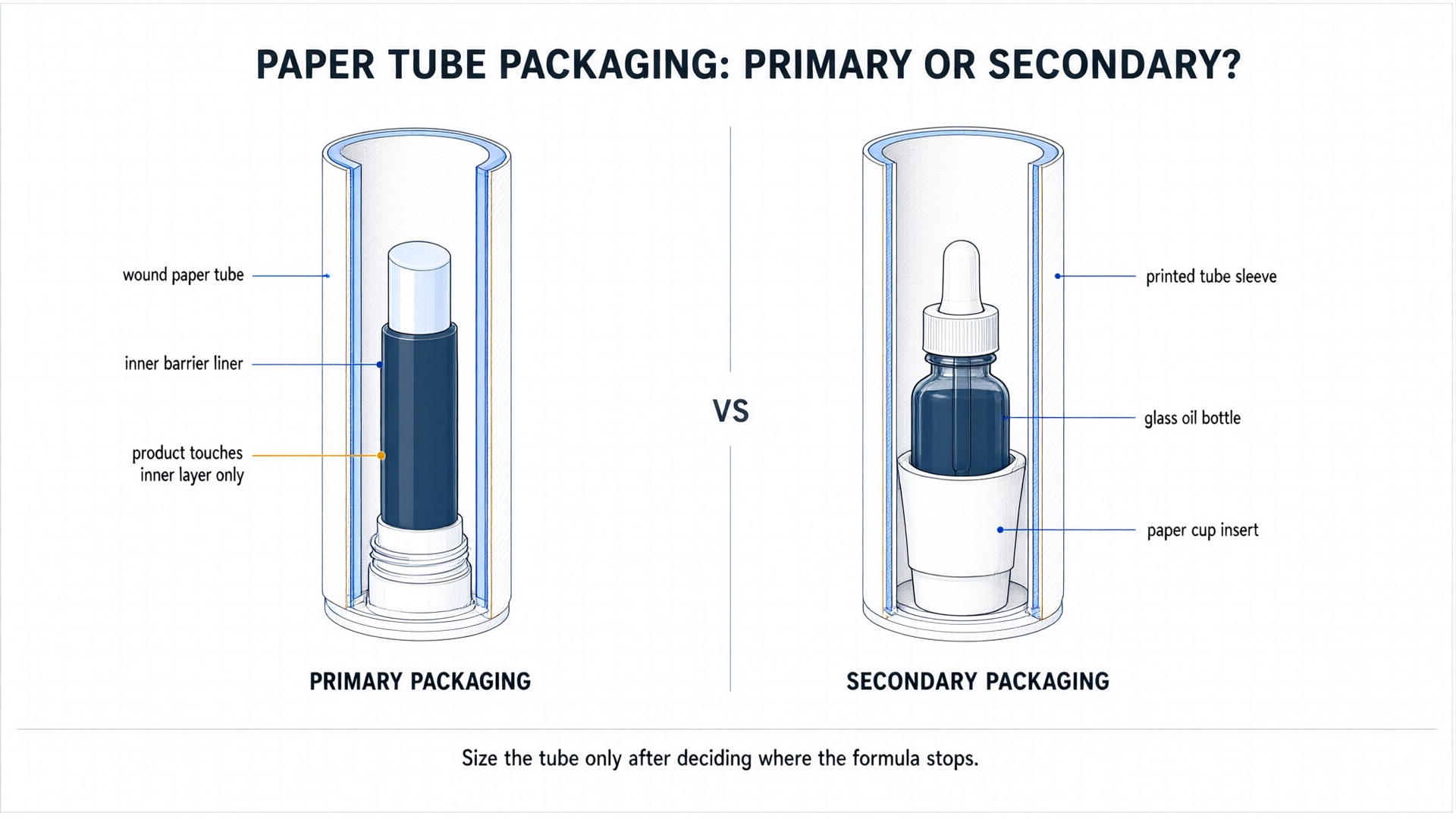
The first question is not how large the tube should be. The answer determines the whole structure. Primary packaging touches the cosmetic product itself; secondary packaging sits around another container. A deodorant stick pressed directly into a tube body is a primary-packaging conversation. An essential oil in a glass dropper bottle, sleeved into a printed tube, is a secondary-packaging conversation.
A plain wound-paper tube is not automatically approved for direct contact with cosmetics. Paper is porous and greasy or volatile formulas migrate into the fibers, discolor the wall and change the dose. Where direct contact is required, we specify a food-grade or cosmetic-compatible inner layer — a laminated liner, a PE coating, or an inner vessel — and validate it with the actual formula. When in doubt, keep the paper tube as the outer shell and house the product in glass, metal or a tested plastic insert.
Diameters, Heights, and Product Clearance
Cylindrical formats are specified by inner diameter (the usable cavity) and height, and the mechanism or vessel dictates the cavity. In our export projects the common territory looks like this:
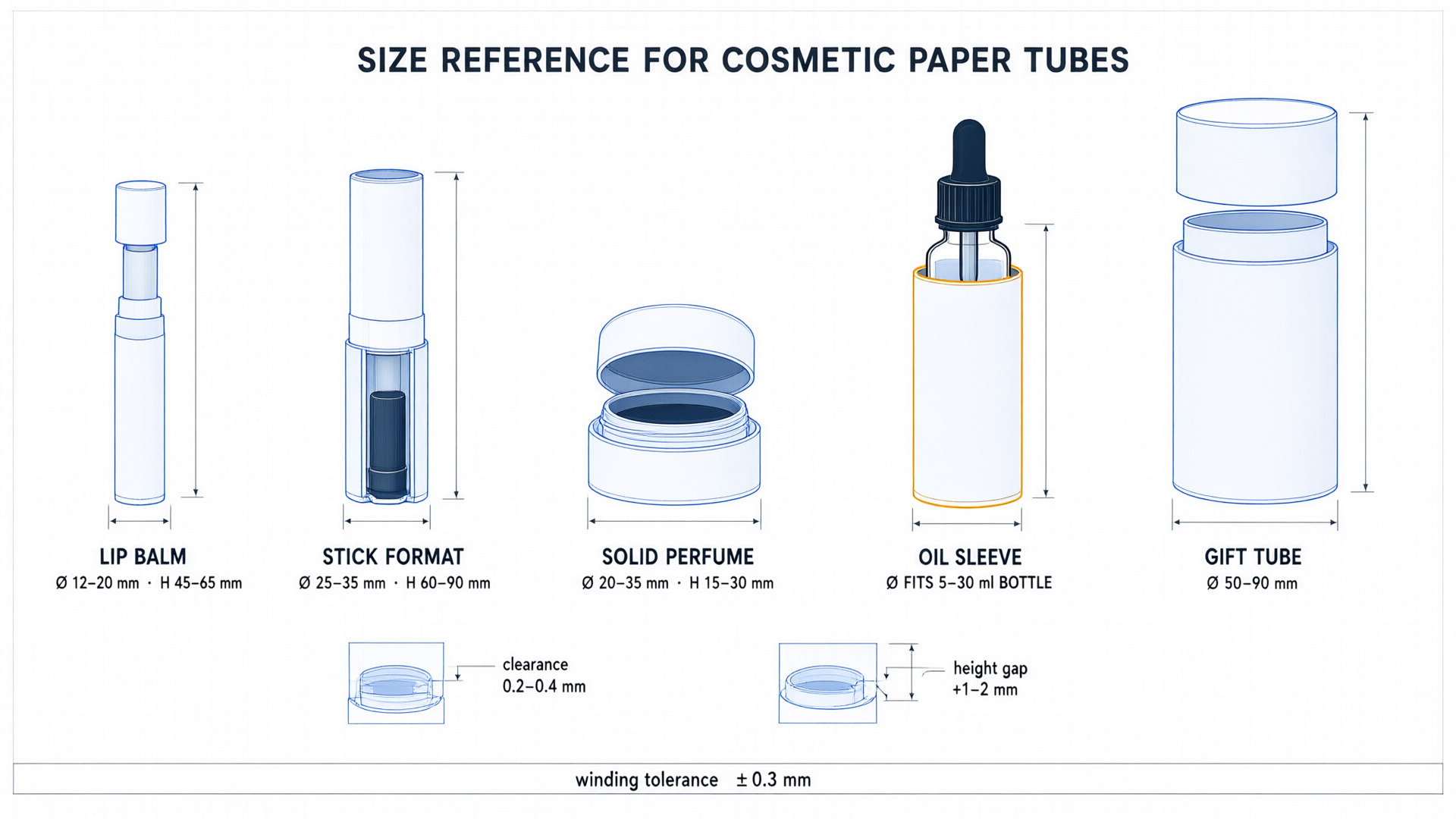
Lip balm and balms on a push-up mechanism: inner diameter around 12–20 mm, height 45–65 mm; a 4–5 g balm sits at roughly 19 mm. Deodorant and skincare stick mechanisms: inner diameter 25–35 mm, height 60–90 mm, taking fills from 25 g up to 75 g. Solid perfume: shallow cylinders from 20 mm to 35 mm diameter and 15–30 mm height, often with a screw ring or nested cap. Essential oils: the tube carries a 5–30 ml bottle, so the cavity is sized to the glass plus a holding cup rather than to the liquid volume. Cosmetic gift sets: larger tubes from 50 mm to 90 mm diameter, used as a presentation sleeve with an internal tray.
To these numbers add clearance. The cavity diameter is 0.2–0.4 mm wider than the mechanism so it slides down without binding, and tube height leaves 1–2 mm under the shoulder for seating. On a production line, wound paper runs within a tolerance of about ±0.3 mm on inside diameter. A brand that specifies the exact outer dimension of its mechanism, and lets the tube match it with a documented gap, avoids both jamming and rattling.
Wall Construction and Moisture/Oil Barriers
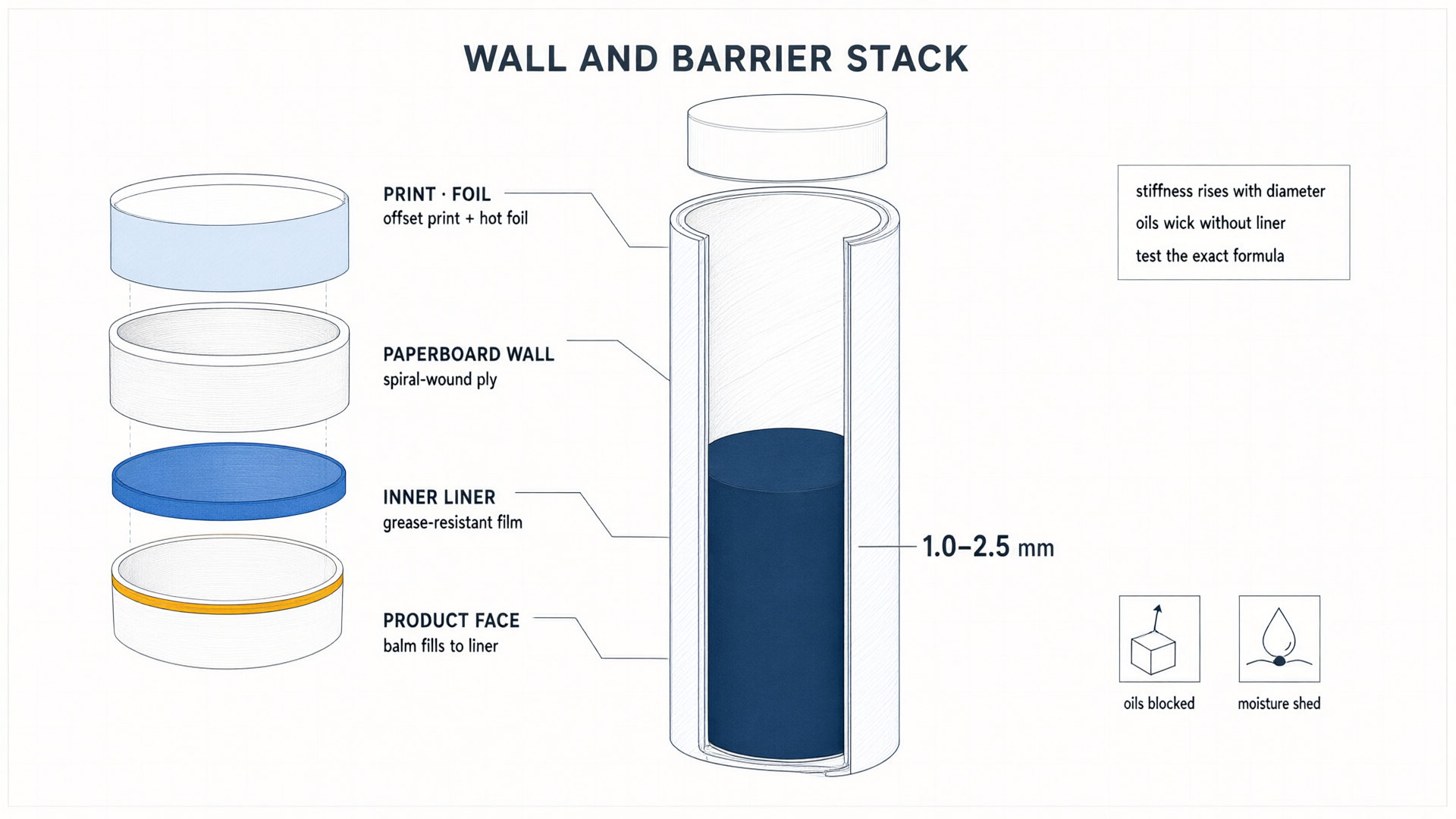
Tube walls are built from spiral-wound paperboard in layered plies; total wall thickness for cosmetic formats usually lands between 1.0 mm and 2.5 mm, with thicker walls for tall gift tubes. Wall strength matters at the cap seam and the bottom chime, where crushing during cartoning shows up as customer returns. Stiffness rises with diameter and wall thickness faster than with board weight alone, so a 30 mm stick tube with a 1.2 mm wall outperforms a 1.0 mm wall of heavier board.
Barrier, in our experience, decides the shelf life of oily formats. Balm, solid perfume and any wax-rich formula wick grease into raw kraft. We counter this with a grease-resistant inner liner or a PE film lamination on the contact face, and with a moisture-stable outer varnish for humid markets and sea freight, where containers swing through large temperature cycles.
Essential oil projects get the same caution doubled: many undiluted oils soften coatings and plastic liners, so the inner material has to be verified against the specific oil, not against a general “oil resistant” claim.
Closures and Inserts
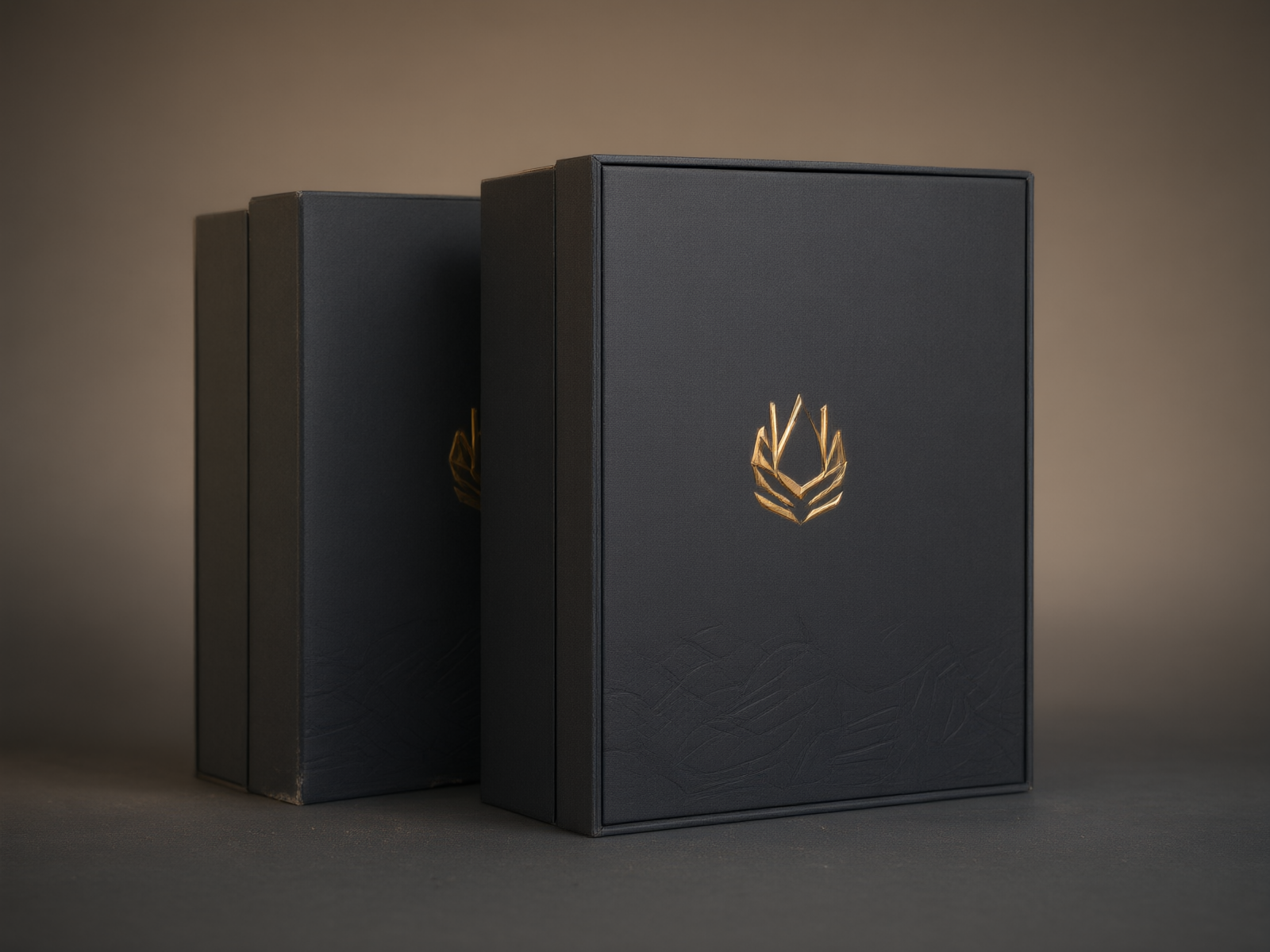
The closure sets the unboxing feel and the retention force. Friction-fit paper and wooden caps read premium but release in warm transit; a telescoping paper-over-board lid tolerates tighter fit; metal end caps with rolled chimes are the choice for stick mechanisms that need the ring anchored.
Inserts finish the job. A paper or molded cup holds a dropper bottle against the wall; a flocked EVA tray carries gift-set components; a threaded ring retains a solid perfume pan. We cut insert depth to the product height minus the clearance calculated above.
Printing, Foil Stamping, and Embossing
Offset printing on a pre-wrapped or post-wound tube carries photographic artwork and Pantone-matched brand colors; flexographic printing covers kraft-based eco lines economically. Hot foil stamping — gold, silver or holographic — reads best on small marks such as a logo or a brand line, because foil tooling cost scales with stamped area.
Embossing and debossing work cleanly on rigid-walled and wrapped surfaces; deep relief over a spiral seam tends to show the seam line, so we move the design across the seam or keep relief within a flat panel. Aqueous varnish or matte lamination protects the surface from scuffing in export cartons.
Sampling and Quality Control
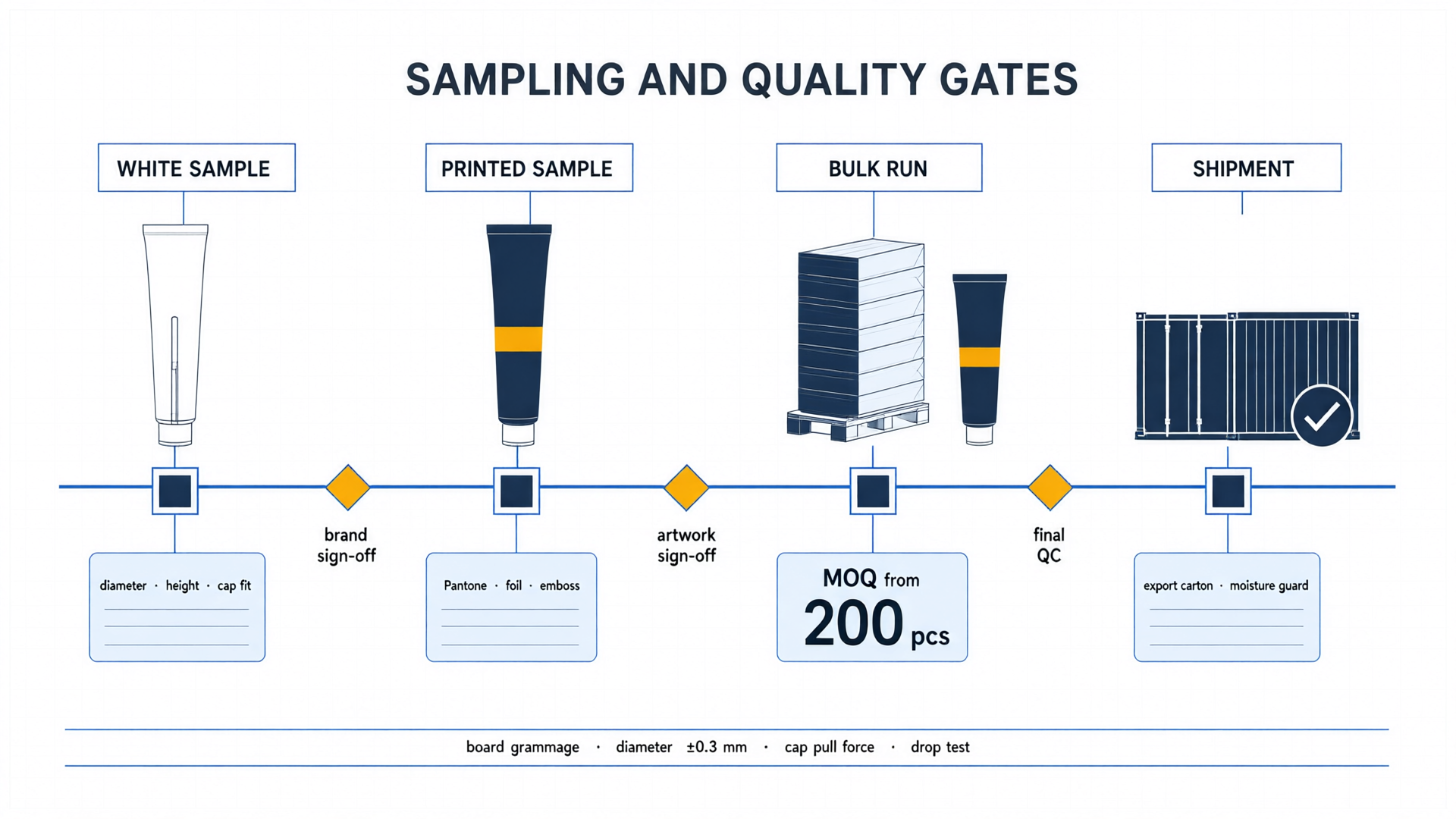
We structure the program in phases. A white sample confirms diameter, height, cap fit and mechanism compatibility before any artwork. A colored printed and stamped sample confirms decoration on the real tube surface and is what brand approvals rest on. Only after those sign-offs does bulk run from our direct factory with low MOQ options starting at 200 pieces.
Incoming board is checked for grammage and moisture; inline checks cover wall thickness, diameter and squareness; finished goods go through cap-removal force, drop testing and color comparison against the approved Pantone or the signed sample. Strict quality control on paper packaging is largely dimensional control, since a tube that fits the mechanism will usually fill, seal and ship without complaint.
Frequently Asked Questions
Is a custom paper tube safe for direct contact with lip balm or solid perfume?
Only with a verified contact layer. We specify a food-grade or cosmetic-compatible liner or inner coating, and test compatibility with the exact formula before treating direct contact as approved.
Which diameter and height should a deodorant or skincare stick use?
The mechanism dictates: 25–35 mm inner diameter and 60–90 mm height cover common stick formats, with roughly 0.2–0.4 mm radial clearance around the mechanism.
How does an essential oil product fit a paper tube?
The paper tube acts as secondary packaging for a glass bottle. Inserts hold the bottle and the tube gets an inner barrier for insurance against leakage staining during air- or sea-freight temperature swings.
What decoration carries a premium look at export shelf conditions?
Offset or flexo printing with hot foil stamping and embossing on the brand mark, protected by aqueous or matte finish. Foil area drives cost, so small precise marks perform best.
What are the MOQ and sampling times?
Low MOQ options start at 200 pieces; white samples typically return in a few days and printed samples within about a week, before production scheduling begins.
How do you guarantee bulk matches the approved sample?
Multi-stage QC: material inspection on board weight and moisture, inline dimensional checks, and finished-goods verification of cap force, drop resistance and color against the signed sample and artwork files.
Get Started on Your Custom Paper Tube Project
If you are developing paper tubes for skincare, stick formats, essential oil gift lines or cosmetic sets, send us the size, quantity, mechanism drawings or artwork and we will return a structural recommendation and an international quotation.
Free design support, free samples and global shipping door-to-door are included with every project.
Interested in Custom Paper Tube Packaging?
Send us your specifications and get a detailed quote within 24 hours.
Get a Free Quote