Paper Tube Packaging Cost: What Affects Custom Tube Prices?
A detailed breakdown of the cost drivers behind custom paper tube packaging — from structure and wall thickness to printing, finishing, closures, quantity and logistics — so procurement teams can compare quotations on the same terms.
A custom paper tube is easy to specify and surprisingly hard to price. Two brands can request a cylinder of the same diameter and the same height and receive two quotations that differ by more than forty percent.
At BOYU LUXE PACK we produce custom paper tubes as a direct factory in Shenzhen, and we see this question on almost every inquiry. The price is not set by the silhouette of the tube. It is set by the sum of the decisions inside that silhouette: the paper, the wall, the surface, the closure, the quantity and the logistics. The layers below break each one down so procurement teams can compare quotations on the same terms and see where their budget actually goes.
Structure First: Diameter, Height, Wall Thickness and Paperboard
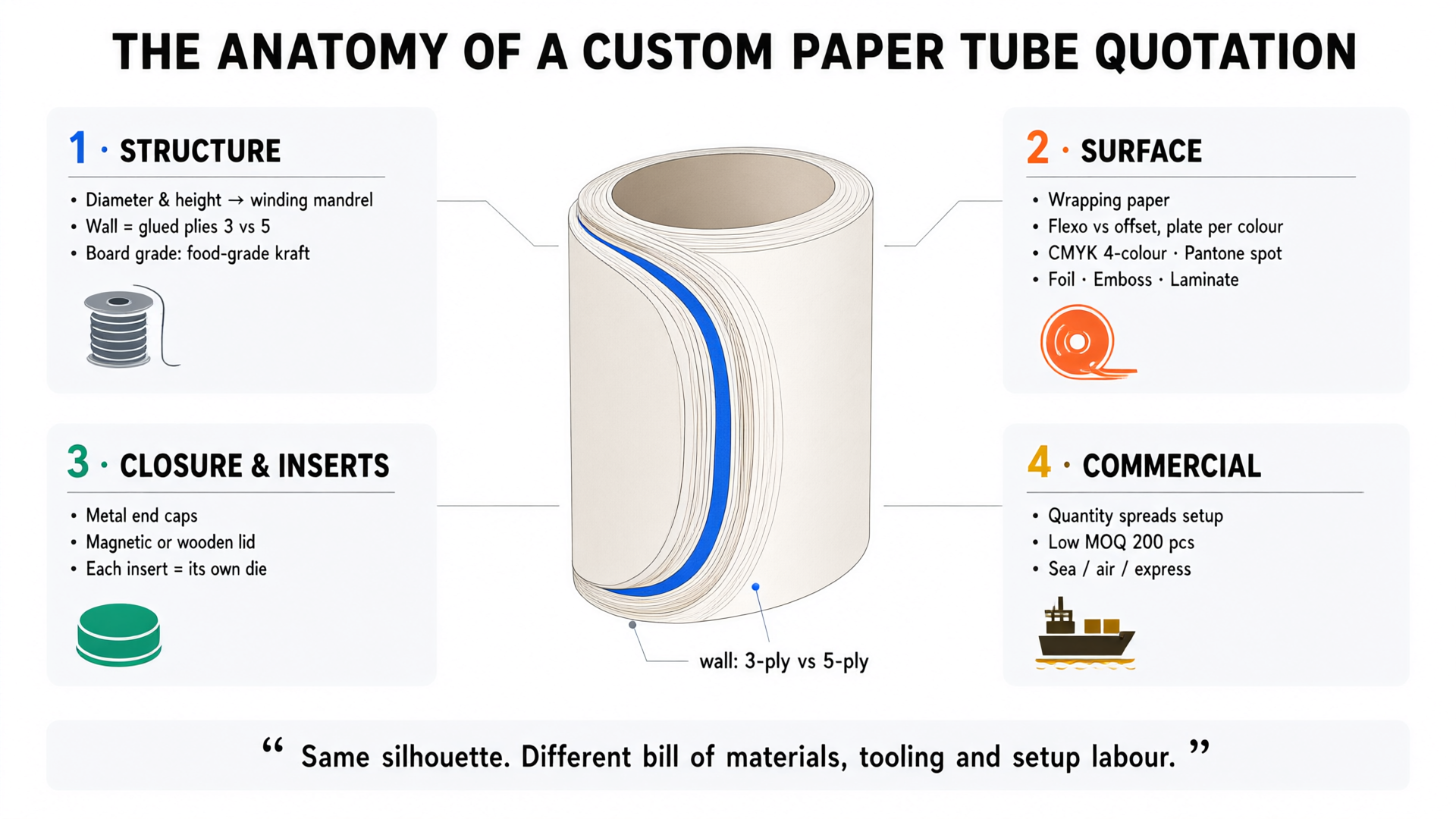
The two dimensions every buyer lists — diameter and height — drive the tooling rather than the material. A wider or taller tube requires a different winding mandrel and a longer spool, and a diameter outside a factory’s standard range means a custom mandrel and a setup charge. Height determines how many linear meters of board are consumed, so a tall tube costs more in paper than a short one even when the finishing is identical.
Wall thickness is the most under-specified variable in most inquiries. Spiral-wound paper tubes are built from multiple glued layers, and each added layer raises rigidity, crush resistance and board weight. Moving from a three-ply wall to a five-ply wall does not change the appearance of the tube, but it changes the tonnage of board, the number of glue passes through the machine and the production cycle. Wall thickness, not diameter, is why a tube that feels premium in the hand carries a premium cost.
Paperboard specification follows the same logic. Standard board, grey board, chipboard and food-grade kraft behave differently and clear different compliance bars. A tube used for tea, coffee or cosmetic refills may require food-safe or FSC-certified stock, and certified material is more expensive at the source before any printing has begun.
Surface and Finishing: Wrapping Paper, Printing, Foil, Embossing and Lamination
The outer wrapping paper sets the color base and the texture. White kraft takes ink cleanly and keeps costs moderate, while a textured or specialty paper raises the per-meter material price and adds a manual lay-up step for the operator.
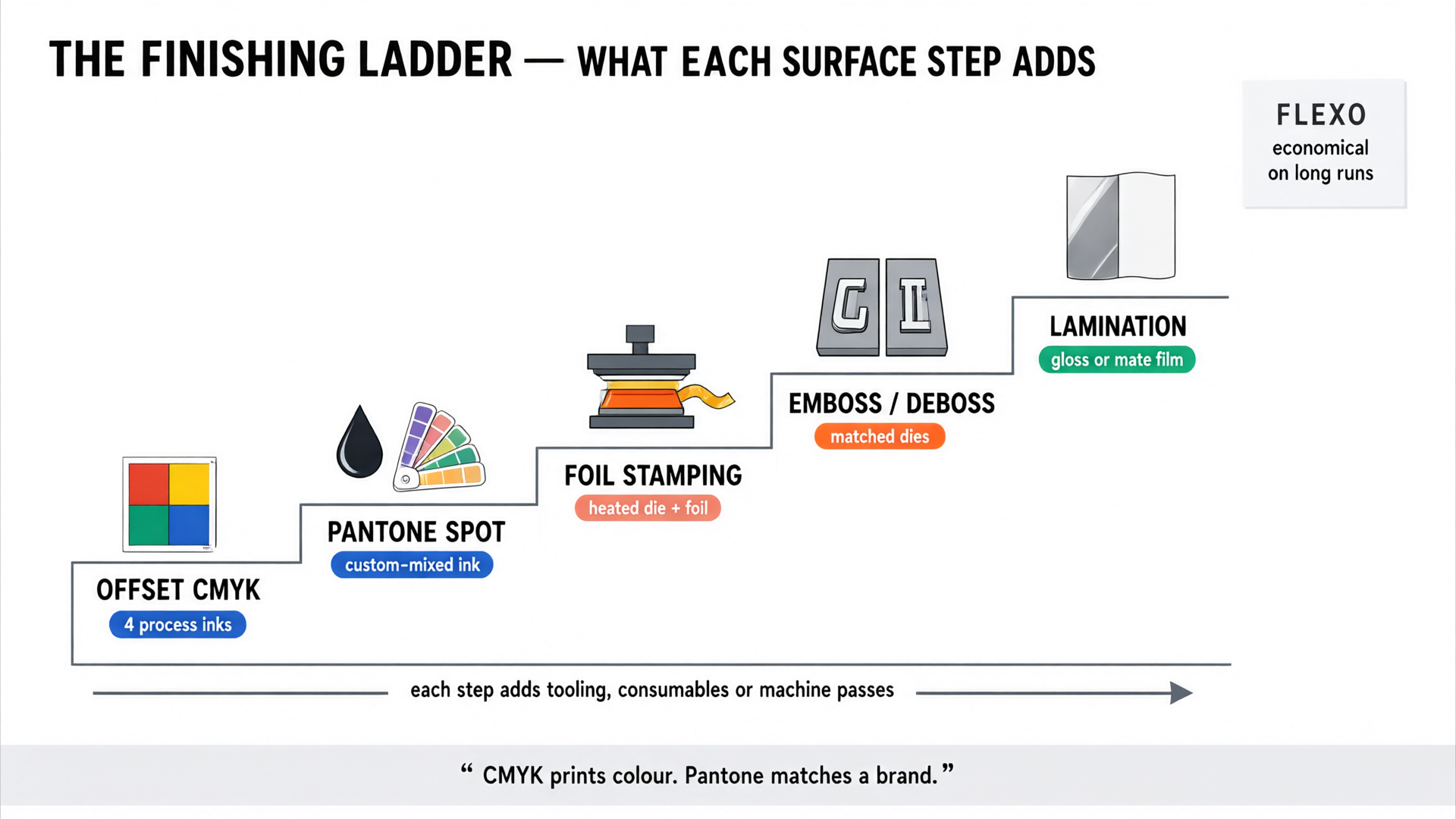
The printing method is a fork in the road. Flexography is economical for simple two- or three-color repeats on long runs. Offset printing delivers photographic detail but demands a plate for every color and a run long enough to amortize those plates. The correct answer depends entirely on design complexity and quantity.
CMYK versus Pantone is a frequent point of confusion and a frequent cost gap. CMYK builds a full-color image from four process inks and is the standard choice for gradients and photographs. A brand color, such as a registered corporate tone or a metallic gold matched by eye, requires a spot Pantone ink. Pantone jobs add a custom-mixed ink and, when multiple spot colors are used, additional press passes. Foil stamping pushes the line again: a heated metal die is cut from the artwork, and the foil itself is a separate consumable. That die is a tooling cost a plain-printed tube never incurs.
Embossing and debossing follow foil’s pattern. They need matched female and male dies, so the artwork is converted into a physical tool, and embossing a large area on a curved surface is harder than on a flat box. Lamination seals the wrapping paper under a thin film. Gloss or matte polypropylene film protects the surface and improves the feel, but it adds a laminating pass and a material line that a bare tube does not carry.
Closure and Inserts: The Lid and the Inner Structure
The lid and closure form a separate assembly with their own cost drivers. A simple paper-over-cap lid is inexpensive. A metal end cap, a wooden top or a magnetic or friction-fit premium closure introduces components sourced from a second supplier and an extra assembly step. Inner inserts — card trays, foam cutouts, satin lining, product cradles — are often the hidden majority of a quotation, because each one needs its own die and its own station in the assembly line.
The Commercial Variables: Quantity, Sampling, Packaging and Shipping
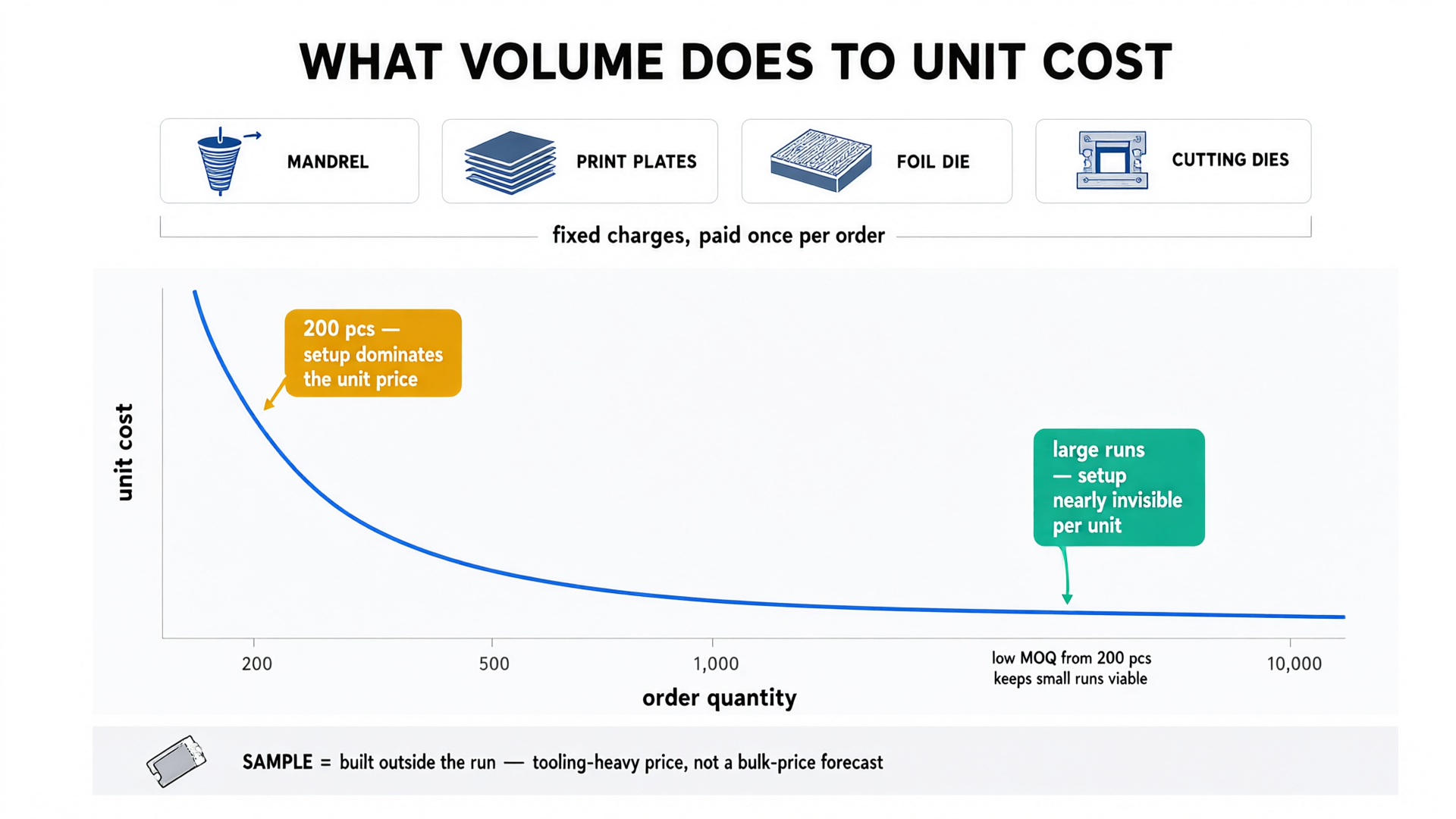
Order quantity compresses the setup cost of every job. Mandrels, printing plates, foil dies and cutting dies are one-time charges. Spread over a thousand tubes they are negligible; spread over two hundred they dominate the unit price. This is our low MOQ starting at 200 pieces: low-volume runs are entirely viable, but the buyer should expect the first tubes to carry more of the overhead.
Sampling is a one-off build outside the production line, so a physical sample is priced above the bulk unit cost by design, and our free samples program exists to let a buyer validate surface, wall and closure before committing to that tooling spend.
Packaging and shipping complete the picture. The export carton configuration, pallet loading, whether the order is nestable or bulky, and the route all change the delivered price. Our export experience across the USA, Europe, the Middle East and Southeast Asia is priced into door-to-door options; sea, air and express each move the total, and a tube assembled at the destination ships differently from one shipped as a finished cylinder.
Why Two Identical Tubes Price Differently
Pulling it together: two tubes of the same diameter and same height can be priced far apart because one is three-ply and the other is five-ply, one carries flexographic CMYK and the other a Pantone mix with foil stamping, one has a paper cap and the other a metal end with a foam insert, and one runs a thousand units while the other runs two hundred. The silhouette is the same. The bill of materials, the tooling and the setup labor are not.
The lesson for buyers is that “same size, same quote” is a false comparison, and comparable quotations require a comparable specification.
A Checklist for Requesting Comparable Quotations
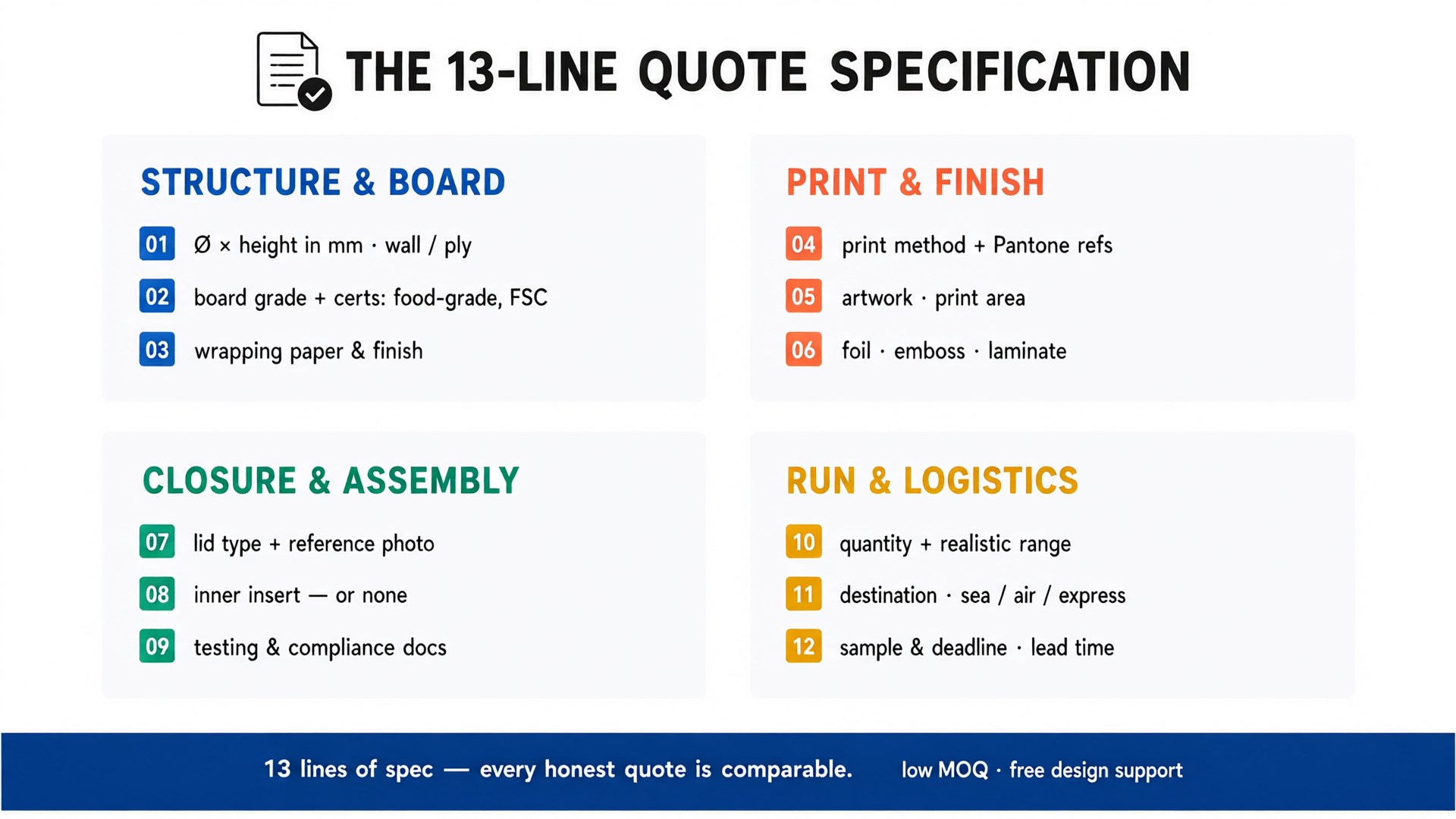
To get quotes that line up side by side, send every manufacturer the same information:
1. Inner diameter and inner height in millimeters, plus the required wall thickness or ply count. 2. Paperboard grade and weight, and any certification needed, such as food-grade, FSC or recycled content. 3. Outer wrapping paper type and finish, or confirmation that the board is printed directly. 4. Printing method, with Pantone references for every brand color. 5. Artwork or a mock-up, identifying the surface area to be covered. 6. Finishing requirements: foil stamping, embossing or debossing, gloss or matte lamination, spot UV. 7. Lid and closure type, with photos of any reference style. 8. Inner inserts, or confirmation that no insert is required. 9. Target quantity, with a realistic range if the first order is uncertain. 10. Destination port or delivery city and the preferred mode: sea, air or express. 11. Sample requirement — stock, custom or none — and a target sampling deadline. 12. Testing, certification or compliance documents required for your market. 13. Expected lead time, so the factory can plan around our strict quality-control inspection stages.
Frequently Asked Questions
Why does quantity affect unit price so strongly?
Most of the heavy cost of a custom tube is fixed and paid once. The die, the plate and the mandrel stay the same whether you make two hundred units or ten thousand. A larger run divides that one-time charge over a greater number of pieces, so the per-unit price falls as volume rises.
Does custom printing increase cost?
Yes, in direct proportion to what the design demands. Extra colors mean extra plates and extra press passes, and brand-matched Pantone ink costs more than standard process color because it requires a custom mix and a dedicated setup.
Does foil stamping increase cost?
It does. Foil requires a heated die cut to your artwork, a separate foil consumable and its own machine pass. The die is charged once per order, which means foil rewards long runs and punishes very short ones.
Why can sample pricing differ from bulk pricing?
A sample carries all of the tooling and setup cost on a single unit, while bulk production reuses that setup across the whole run. The sample price is therefore a tooling-heavy figure and not a forecast of the bulk unit cost.
What information should I provide for an accurate quotation?
The checklist above in full. Each missing line invites a guess from the factory, and every guess becomes a variation in the number you receive. Complete specification produces comparable pricing.
Get a Quote You Can Compare
Pricing paper tube packaging is an engineering conversation, not a price list. As a direct custom packaging manufacturer combining custom manufacturing capability, free design support and global shipping, BOYU LUXE PACK supports that conversation from structural draft to delivered pallet.
Send the size, quantity, artwork or a reference image, and we return a specification-based quotation you can compare line by line against any supplier. Get a free quote and request free samples — see the quality before you order.
Interested in Custom Paper Tube Packaging?
Send us your specifications and get a detailed quote within 24 hours.
Get a Free Quote