Custom Paper Tubes for Cosmetics, Skincare & Essential Oils: Size and Design Guide
A technical guide covering diameter clearance, wall construction, moisture resistance, printing and finishing options for custom paper tubes used in cosmetics, skincare and essential oil packaging.
Cylindrical paper packaging moved from the tea and gifts aisle onto beauty shelves for a practical reason: a paper tube protects a slim, fragile container better than most folding cartons, survives parcel shipping, and reads as premium at a fraction of rigid-box cost. For skincare serums, essential oil bottles, lip balms and deodorant sticks, the format solves several problems at once. Most of those problems come down to sizing.
We manufacture custom paper tubes at our own facility, and the mistakes we see in buyer briefs rarely involve printing quality. They involve clearance, wall construction and the wrong assumption about what a tube is actually allowed to touch.
Primary or Secondary: Define the Tube’s Role First
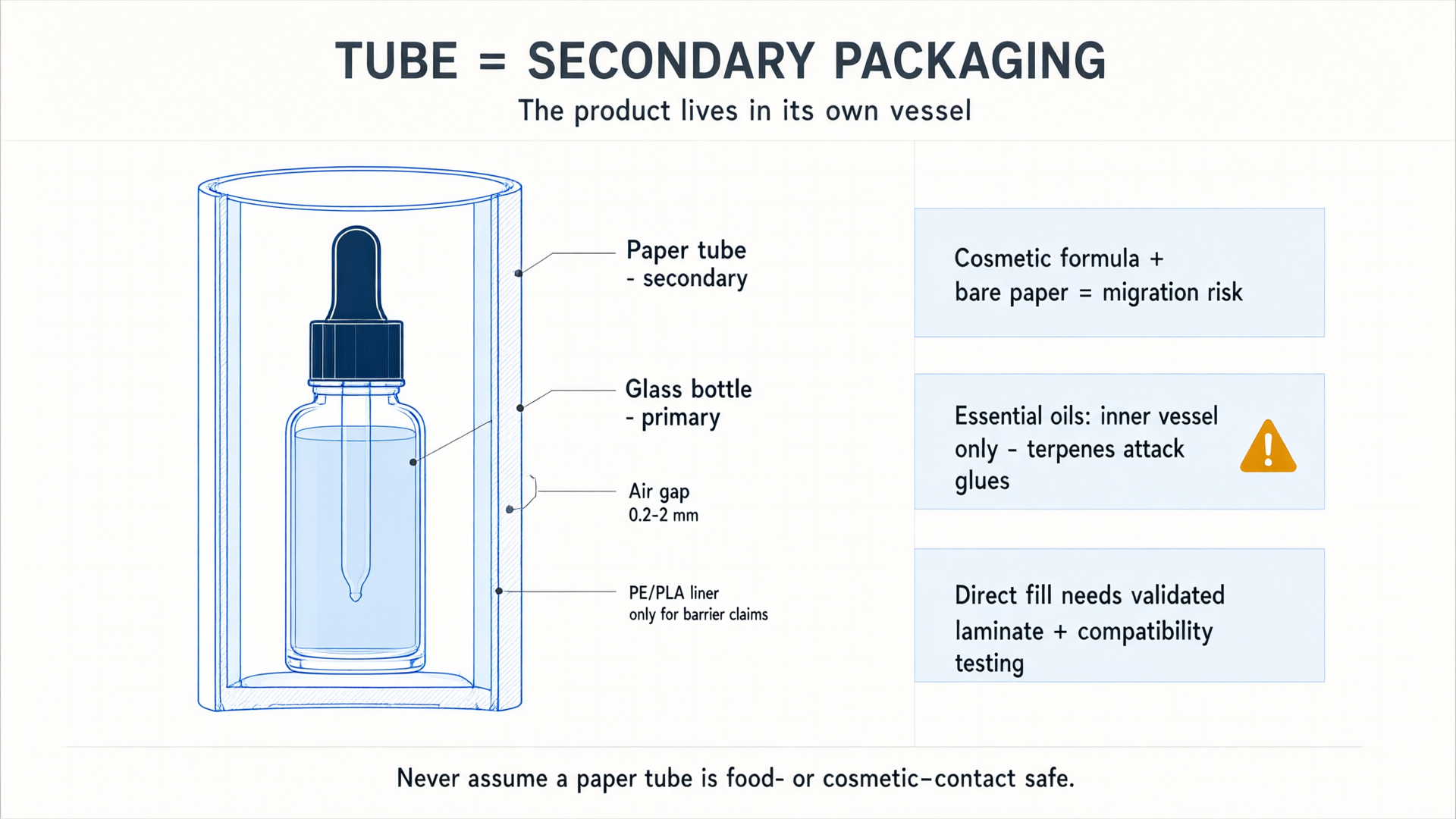
The first structural decision is whether the tube is primary packaging or secondary packaging. Primary packaging touches the product itself; secondary packaging wraps around it. A paper tube is secondary packaging in almost every beauty application. The product sits in its own vessel — a glass bottle, a PE or PP wand tube, an aluminium tin, a moulded stick mechanism — and the paper tube surrounds that vessel as the outer shell.
This distinction matters for compliance and for cost. Paper is a porous, fibre-based material: adhesives, inks and kraft fibres can interact with cosmetic formulae, and most paper tubes are not engineered for direct filling. Buyers should not assume that a tube can hold a product directly unless it carries a verified inner barrier and has passed compatibility testing on the specific formula. For essential oils in particular — where terpenes aggressively attack coatings and glues — the correct architecture is a glass or metal inner vessel inside the tube, not bare paper.
Diameter, Height and Clearance
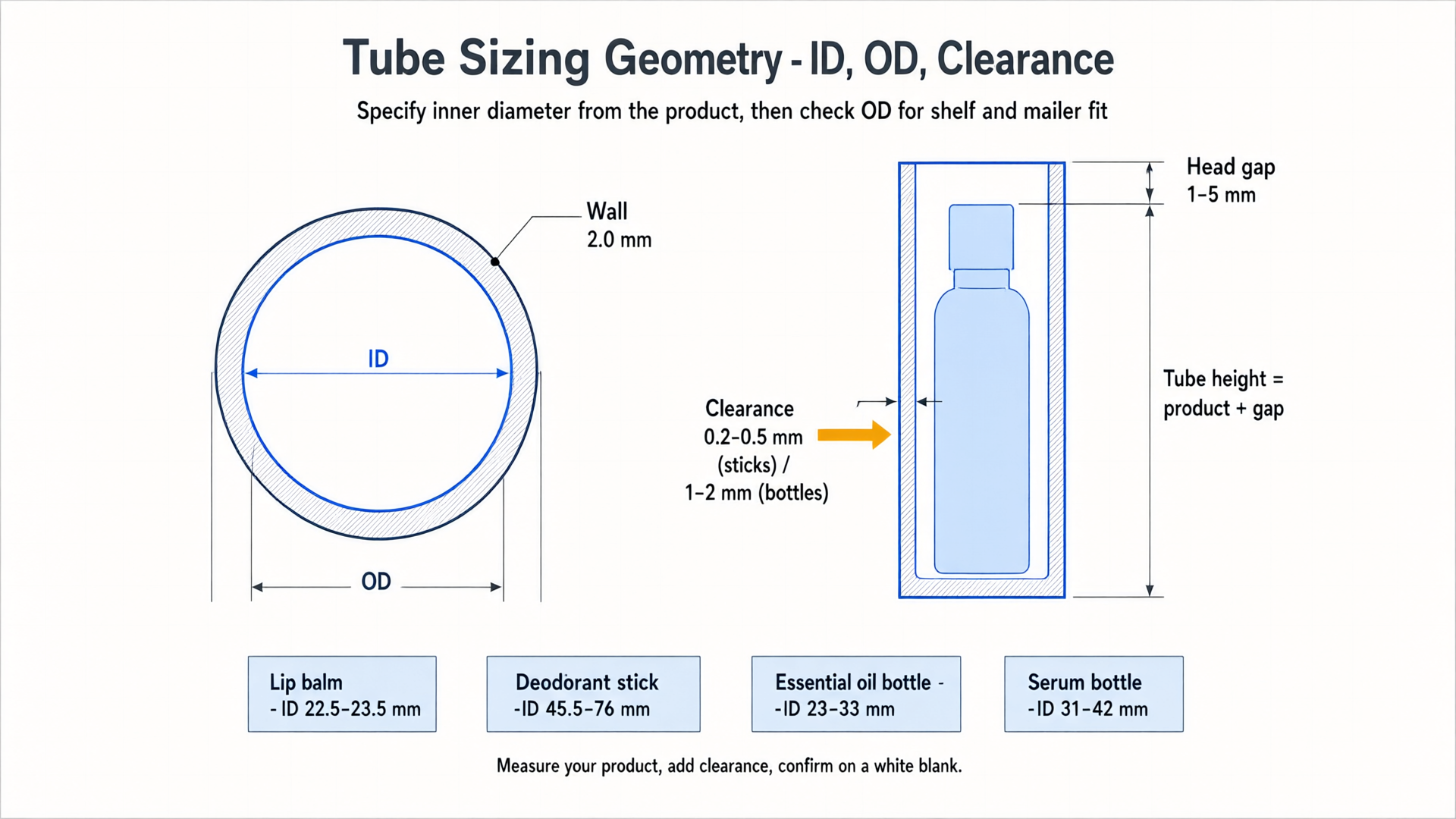
Tube size follows from product size plus clearance, the working gap between the product and the tube’s inner wall. Clearance too small and the product binds or the assembly bulges; too large and the contents rattle, tip and abrade the print. As a specification range, rigid formats such as stick mechanisms and solid perfumes sit around 0.2–0.5 mm per side on the inner diameter, while bottles and jars that need to slide out by hand need roughly 1–2 mm per side. Height adds a 1–5 mm head gap depending on closure style.
Lip balm: typical product Ø 21–22 mm stick, suggested tube ID 22.5–23.5 mm, typical tube height 45–60 mm.
Deodorant / balm stick: typical product Ø 45–75 mm mechanism, suggested tube ID +0.5–1 mm, typical tube height 70–125 mm.
Solid perfume: typical product Ø 40–55 mm compact, suggested tube ID +0.5–1 mm, typical tube height 25–45 mm.
Serum / cream bottle: typical product Ø 28–38 mm body, suggested tube ID 31–42 mm, typical tube height 80–150 mm.
Essential oil bottle (5–30 ml): typical product Ø 19–28 mm with dropper, suggested tube ID 23–33 mm, typical tube height 65–95 mm.
Cosmetic gift set: 2–5 mixed units, custom layout, typical tube height 120–220 mm.
One engineering note that catches buyers out: inner diameter (ID) and outer diameter (OD) differ by twice the wall thickness. A 2 mm wall on a serum tube with 33 mm ID measures 37 mm OD — and shelf facings, mailer boxes and e-commerce cartons all key off OD.
Wall Construction and Inner Components
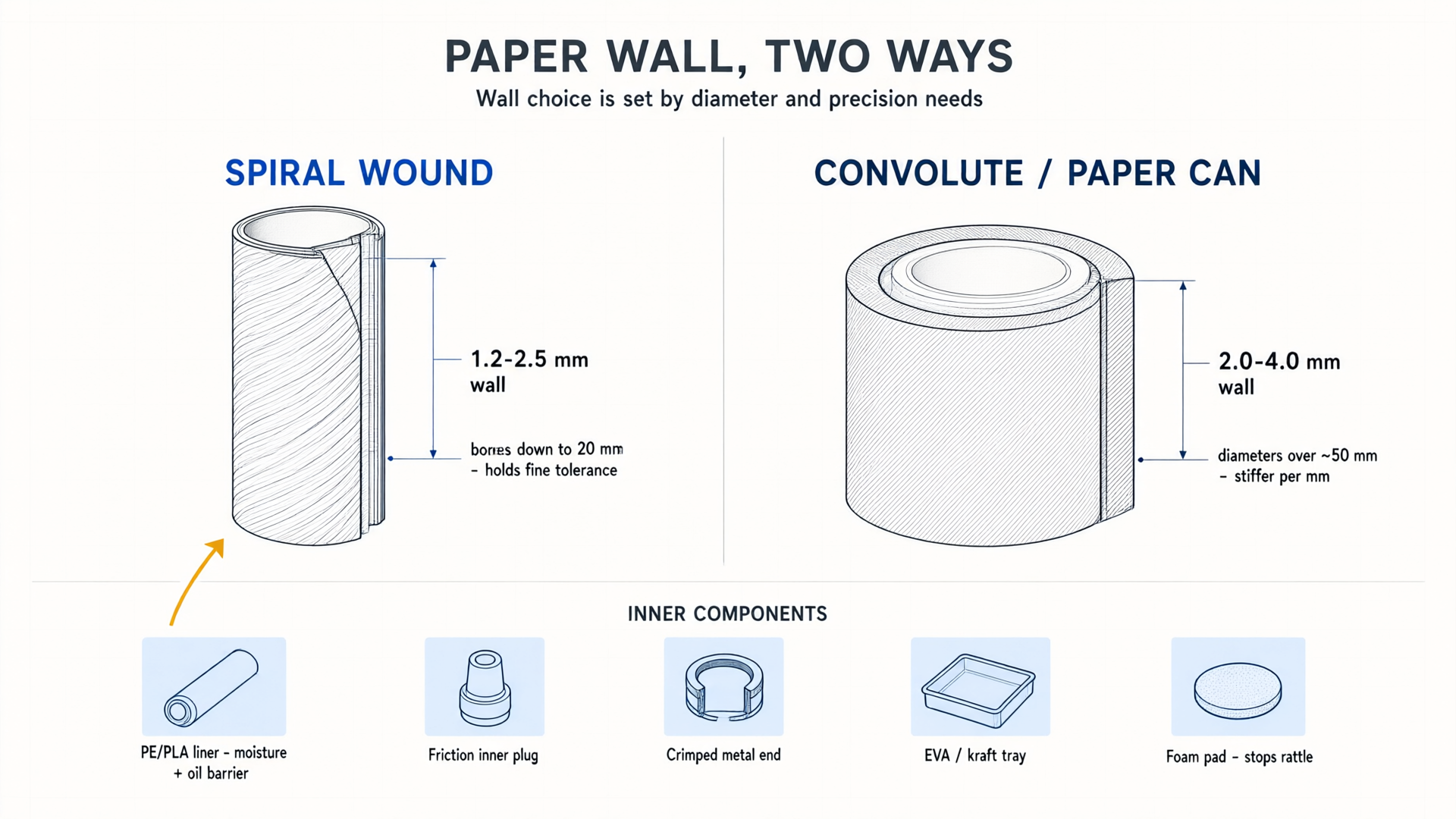
Slim diameters call for spiral-wound construction: kraft or board plies wound on a mandrel under tension and adhesive, producing a dense, dimensionally stable wall in the 1.2–2.5 mm range that holds fine tolerances down to 20 mm bores. Larger or shorter formats use paper-can (convolute) walls of 2.0–4.0 mm, stiffer per millimetre and suited to diameters over 50 mm.
Inner components decide whether the tube behaves like functional packaging or a decorative sleeve: friction-fit inner plugs, PE or PET liners, crimped metal ends, push-up bases, cork stoppers and foam pads. These parts also carry the barrier if the design needs one near the product, since glass bottles still need restraint from vertical movement with a pad or tray.
Moisture and Oil Resistance
Paper loses stiffness when humidity moves through it, and cosmetic oils migrate through uncoated fibre. The practical toolkit is an inner PE or PLA film laminate for moisture and grease resistance, barrier-coated grades where a plastic-free claim matters, and a protective overprint varnish on the exterior for scuff and fingerprint resistance during retail handling. Where a formula has genuine solvent or terpenoid load, the barrier belongs in the inner vessel — the tube takes the mechanical and branding job instead.
Printing, Foil Stamping and Embossing
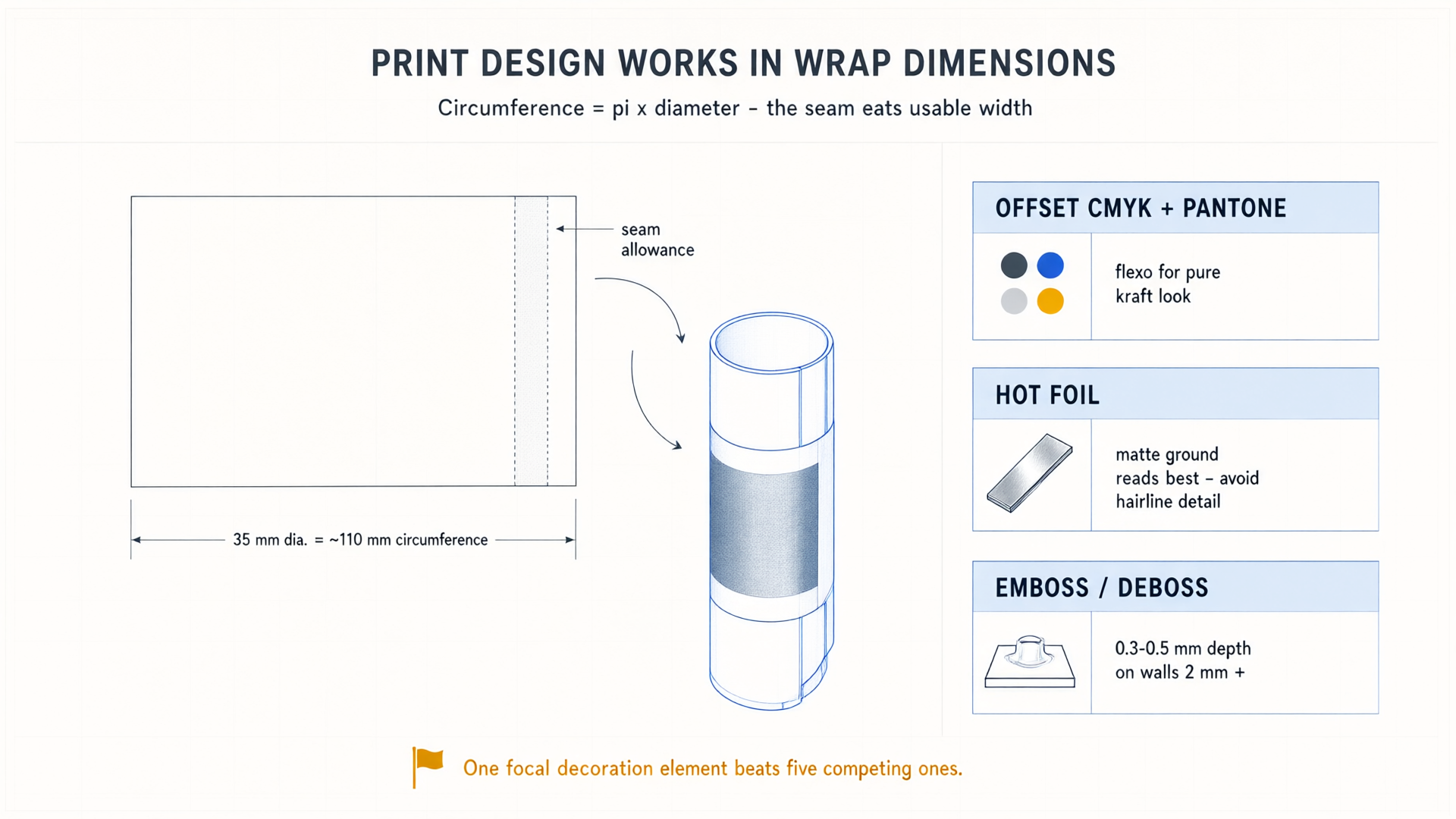
On a cylinder, artwork is planned in wrap terms: circumference is π × diameter, so a 35 mm tube prints across roughly 110 mm of circumference minus the seam allowance. We run offset lithography for full-colour and Pantone work, and flexography on natural kraft when a simpler, eco-facing print is wanted.
Foil and embossing on curved paper behave differently than on carton board. Hot foil stamping reads strongly on matte surfaces and pairs well with a dark kraft ground; register on a curved wall is looser than on a flat sheet, so hairline foil detail and registration-dependent multi-colour foil should be avoided. Embossing and debossing need wall rigidity to hold relief depth without print cracking — a stable surface for logo marks, with a shallow depth in the 0.3–0.5 mm range on 2 mm-plus walls.
Closures and Inserts
Closure choice governs user experience and shipping cost. Friction-fit wooden or kraft caps give a premium unboxing feel and ship loose-packed for the end user to assemble; screw caps with inner plugs suit travel products and heavier oils and require torque and drop verification; crimped or seamed metal ends make the tube effectively a can, which suits deodorant and balm formats that need an exposed product face.
Inserts finish the interior: EVA or kraft trays that locate each unit of a gift set, card dowels that lift a serum bottle to display height, and ribbon pulls for drawer-style tubes. A gift set with three different SKU heights almost always needs a stepped insert cut to each unit’s tolerance.
Sampling and Quality Control
A disciplined custom tube project moves through four gates: stock samples to judge paper and finish, plain white blanks for dimension and product-fit trials, printed pre-production samples with foil and embossing for signature, and sealed first-article samples held as the bulk reference.
For incoming inspection, we check diameters and heights against the drawing with calipers, verify wall thickness and adhesion, and test closure withdrawal force and assembly repeatability. Decoration is signed off against Pantone references or a printed standard, and finished cartons are checked for transit damage. Tolerance discipline at the blank stage saves entire production runs at decoration — dimensional drift on a mandrel also drifts the print seam.
Custom production from BOYU LUXE PACK starts at 200 pieces per design, with free design support through structural layout and dieline artwork.
FAQ
Can a paper tube hold my cosmetic product directly?
Rarely. Paper is porous and interacts with formulae. Direct contact needs a food- or cosmetic-grade inner laminate plus compatibility testing on the actual product. Essential oils in particular require a glass or metal inner vessel inside the tube.
How do I choose diameter and height?
Measure the product’s outer diameter and height, add clearance (0.2–0.5 mm per side for rigid formats, 1–2 mm for slide-fit bottles) and a 1–5 mm head gap, then confirm the resulting inner diameter against available tube sizes by trialling a white blank with the product.
What wall structure should I specify for slim lip balm tubes?
Spiral-wound walls in the 1.2–1.8 mm range hold tight tolerances on small diameters more reliably than thicker paper-can walls, which are better for diameters over roughly 50 mm.
What are the finishing options for a luxury look?
Matte or soft-touch lamination, single-colour hot foil for a logo, shallow embossing of brand marks, and a contrasting cap material such as wood or cork. One focal decoration element outperforms several competing ones on a curved surface.
What is the minimum order quantity and the sampling process?
Custom runs start at 200 pieces. Stock samples are free for material evaluation, custom white blanks cover fit verification, and a printed pre-production sample is signed before bulk decoration runs.
How is quality verified before shipment?
Dimensional checks against the drawing, wall thickness and adhesion, closure force testing, colour matching against a signed standard, and transit-ready carton inspection with export packing.
Get Pricing for Your Tube Specification
A quotation is accurate only when the diameter, height, wall construction, liner, closure and decoration list are fixed. Send the product dimensions or a physical sample, target quantities and artwork references to sales@ecopaperpackaging.com, or use the inquiry form on our site, for a tailored solution and a free quote; free sample kits are available before tooling begins. We run custom manufacturing directly from our Shenzhen facility for brands in the USA, Europe, the Middle East and Southeast Asia, with global sea, air and express delivery.
Interested in Custom Paper Tube Packaging?
Send us your specifications and get a detailed quote within 24 hours.
Get a Free Quote